

“Our commitment to ESG is embedded in day-to-day operations.”
That sounds like music to the ears of sustainability advocates. This has always been the goal on some level.
But before we get too excited…this quote is from the recent release of the annual report for Diageo, the British spirits multinational (think Johnnie Walker, Guinness, Smirnoff, Tanqueray, Baileys, Captain Morgan).
ESG Metrics: Here Today, Gone Tomorrow
The full context is that the company is removing ESG metrics from the long-term incentive plan for top executives (an enterprising journalist, Fiona Holland, working for www.just-drinks.com, an industry publication, dug this up). I went down the rabbit hole of looking at the (believe it or not) 30-page remuneration plan included in the annual report.
To set the stage here, let me explain their executive pay the best I can. There’s a base salary (for the CEO, it’s ~£1.5 million per year), then two key incentive pay structures: (1) an annual bonus that can range up to 200% of the base; (2) a long-term incentive plan (in two parts), which is paid in stock or options, and will now range up to over 600% of base pay. The elements that are included are clearly not minor since, in total, it can be well over £10 million to just the CEO.
Diageo was applauded in 2020 for adding ESG metrics to its long-term incentive plan (which vests over 3 years, plus a 2-year holding period, so call it a 5-year horizon). The previous version had eight metrics and included 3 or 4 ESG items: carbon reduction, water replenishment, diversity and inclusion, and “positive drinking” (the company’s work on responsible drinking). All of these fell under what the company still calls the “Spirit of Progress,” its sustainability strategy (headline: “Doing business the right way, from grain to glass”).
In total, depending on the year, ESG was 15% to 20% of the long-term bonus. Not decisive, but it sent a signal.
The new long-term incentive plan has just three metrics:
Earnings per share (EPS) growth
Cumulative free cash flow (FCF)
Adjusted return on invested capital (ROIC)
This is on top of the annual bonus which includes 3 others:
Net Sales growth (NSV)
Operating Profit (OP) growth
“Individual Business Objectives”
Ok, so back to the latest annual report. Here’s the key passage underneath the general pronouncement that’s worth reading:
Diageo was market-leading in 2020 when including Environmental, Social, and Governance (ESG) measures in our long-term incentive arrangements to align with the launch of our ‘Spirit of Progress’ plan. Since then, Spirit of Progress priorities and targets have become firmly embedded in how we operate and make decisions as a business.
Our commitment to Spirit of Progress is unchanged. The Board will continue to set targets, closely monitor performance, and report against all areas of ESG in our Annual Report and other ESG disclosures. The Committee will continue to take this ESG performance into account as part of its holistic assessment of overall business performance before determining vesting outcomes. Additionally, appropriate Spirit of Progress measures continue to be included within the Individual Business Objectives for relevant leaders as part of their AIP.
My Take(s): It Isn’t Pretty
A Significant Pullback
We could allow some benefit of the doubt since the company has supposedly kept its Spirit of Progress work going (on the website at least). But it does feel a bit like they doth protest too much (or not that much since this was all buried).
To be fair, Diageo is in some crisis. A new CEO was brought in to turn things around and he’s likely streamlining everything. And with boards likely simplifying pay metrics (while making sure pay keeps going up of course) the metrics reduction alone isn’t necessarily a big statement on sustainability…but it still says something.
So is sustainability still a priority at Diageo? Not if you look at the strategy of the firm. The core approach of the company, as laid out in the opening of the annual report, has shifted dramatically.
BEFORE:
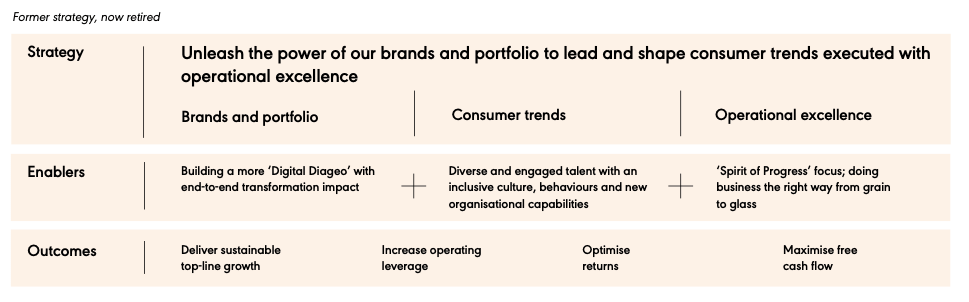
Note the 3 enablers of success: digital transformation, diversity and inclusivity, and “spirit of progress”.
AFTER:
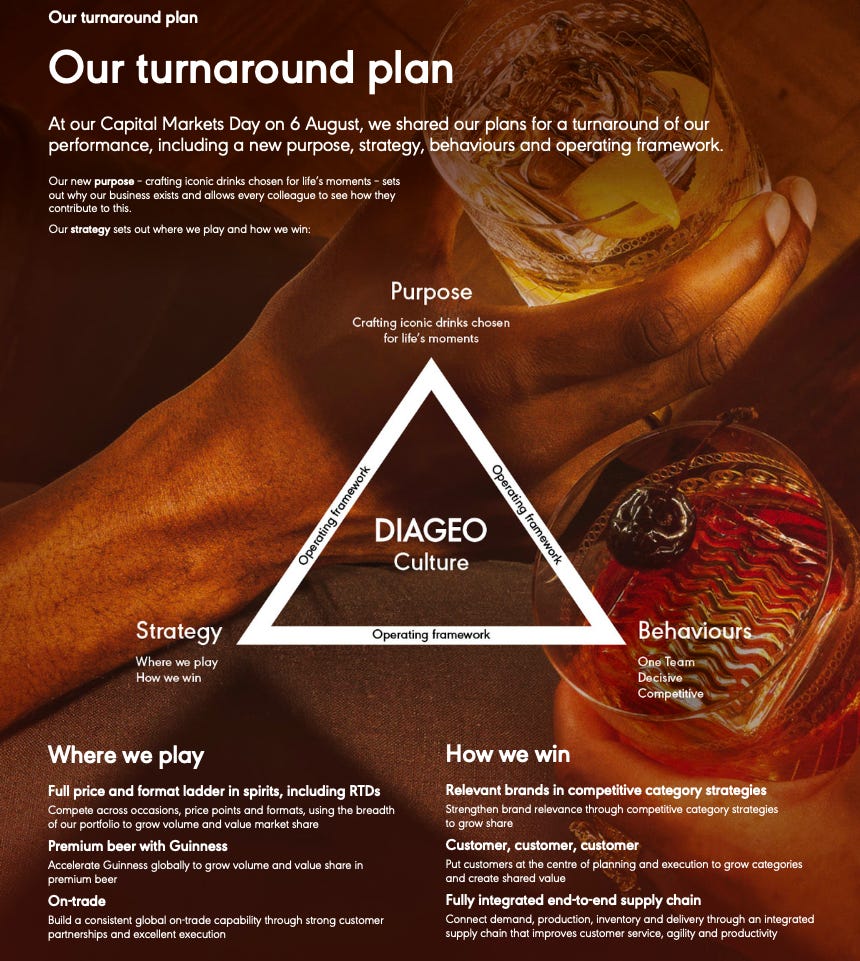
Gone is any mention of diversity and inclusion, sustainable supply chains, responsible drinking, or even digital transformation for that matter. It’s all price points, volume, brand, growth, productivity, and a tiny dash of ‘shared value’ with customers (which means what exactly?).
At best — assuming some Spirit of Progress work continues — we could say it’s a complete rout for the forces of greenhushing, or nearly so (there is some chance that “individual business metrics” will include something non-financial). At worst, sustainability no longer plays any role in the company.
What are incentives for?
Putting aside even the value of pursuing sustainability and all that it can do for reducing costs, managing risk, and driving innovation and brand value, the pullback to almost purely financial metrics tells us really what we need to know about companies today, or at least this company.
It’s kind of funny that their defense of removing all ESG metrics from the considerable pay bump for top execs is that sustainability is so well embedded that they don’t need to incentivize it. There is some kind of logic there, but I’m willing to bet that the desire to hit financial outcomes is also very well embedded in how the business operates. To be cheeky…why do you need all your long-term incentive metrics focused on financial growth?
I’m not being anti-profit. But I am pro-strategic. The original strategy had the benefit of including business enablers. The things they identified before — being on top of digital capabilities, bringing in different views and perspectives on a global business, and embracing sustainable supply chain and agriculture work — all drive the end results, don’t they?
Again, putting aside ESG metrics, where are the metrics for innovation? Or for customer relationships, in particular with younger people who are migrating away from alcohol? Wouldn’t you want to incentivize leaders on their ability to meet younger generations where they are? Or how about metrics on employee engagement?
What I’m saying is that by being dropped from consideration, ESG metrics are in very good company with many other important measures that tell you more about the true health of the business in the long run.
And still, even if the firm is in crisis, there’s a familiar gap in logic here. There’s this base assumption that cutting ESG metrics will help you create more value…or to flip it that sustainability is a drain on long-term value. Who says? And consider this: when you’re trying to reach younger drinkers, they might want to know that a brand stands for something.
So we’re in familiar territory…again. Just as there was an acceleration into sustainability reporting and commitments between the late 2010s and 2022 or so, we now seem to be entering a backward phase of experimenting with nearly ignoring it completely.
I can’t remotely pretend that this is some complete review of all Diageo has done over the years on sustainability (and it has done a lot from responsible drinking to regenerative agriculture). Nor is it an assessment of its true intentions.
I’m just going off what’s stated in the annual report. While there are still many pages devoted to the Spirit of Progress, it’s no longer a priority in the strategy or the metrics that the top execs are measured on.
I have no idea how this will turn out, but I have a hard time believing that companies will be truly successful, ignoring the kind of forces that are reshaping society and the very planet that we live and survive on.
Andrew, this is a fascinating example of the question we've been exploring in our recent exchanges: what does “embedded” really mean?
Responsible Business — through developments such as CSR, sustainability, ESG, stakeholder thinking and purpose — has greatly broadened expectations of business beyond simply maximising shareholder returns. We are calling this evolution Responsible Business 1.0.
Our work on Responsible Business 2.0 asks what comes next: how responsibility towards People • Planet • Ethical Profit can become genuinely embedded in culture, leadership, governance, incentives, systems and everyday decisions — and then protected when circumstances change.
I don't know enough about Diageo to judge what has happened here, but your example raises a much broader question:
Perhaps the real test of whether responsibility is genuinely embedded is whether it endures when leadership changes, commercial pressures increase or priorities shift.
One of the clearest, most obvious fallacies is actually believing that a company "embedding" sustainability and ESG metrics into the fabric of the company represents progress and success. It's complete hogwash. Code for burying it and moving on with the same old financial and operational metrics the economic system "demands." Stop believing this is success. It's not.