
Rational Cowardice?
Why CEO silence makes sense for each company, but is destroying something larger

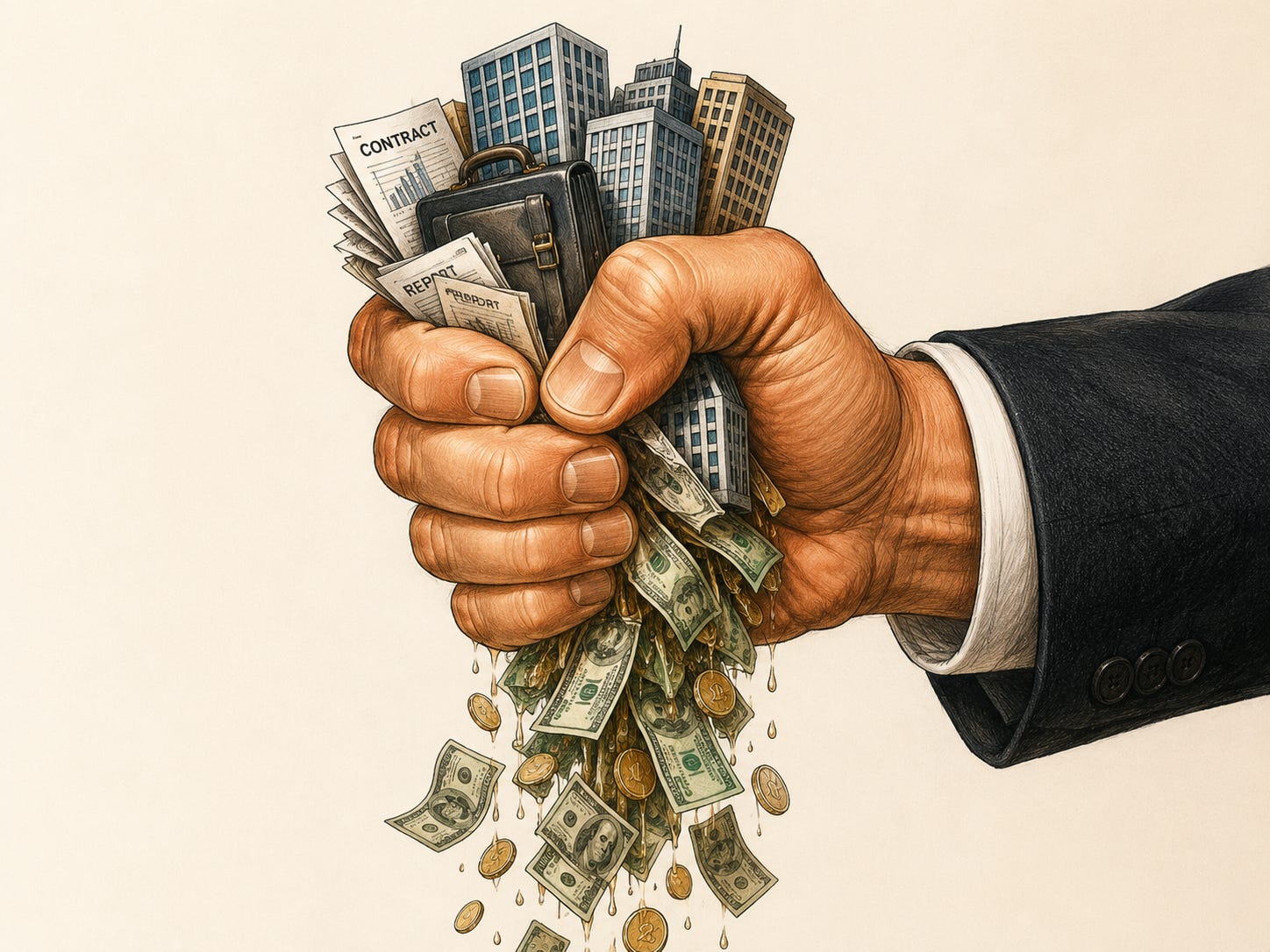
The lack of courage that U.S. business leaders have shown under this administration is breathtaking.
The rhetoric from the right-leaning business community has always been that the "socialist left" is a risk to private enterprise since it will want to control "the means of production." So what do you call a government that takes equity stakes in companies, demands a cut of revenues, and claims veto power over corporate decisions? Because that's exactly what's happening — and the sound coming from business has been crickets.
As democratic norms have collapsed and government has encroached ever more into the private sector — something business used to decry very loudly — we can hear the sound of crickets coming from business.
Here are just a few of the very unusual government actions over the last 18 months…
Taking equity stakes in companies. Last August, the administration took a nearly 10% share of Intel, making it the largest shareholder. CNBC has a running list of 10+ other companies the government grabbed stakes in, many in critical minerals.
Control over corporate decisions. Before approving Nippon Steel’s takeover of U.S. Steel, the government — or to be more specific and corrupt, the president himself — received a “golden share” with veto power over everything from factory closures and relocations to capital expenditure decisions and salaries.
A cut of revenues. Chip giant Nvidia (the world’s most valuable company) was forced to pay the U.S. Treasury 25% of revenue from selling chips to China. As Fortune reported, a law professor emeritus and export clause expert at Case Western called this flatly unconstitutional: "There's no way around it. It's an absolute prohibition, not a recommendation."
Is the outcome of these arrangements sometimes positive for the companies involved, or do they make the government money? Maybe. That’s not the point, is it? Sure, Intel stock has risen lately, but the principle at stake is whether a government should be extracting equity, revenue shares, and operational control from private companies as the price of doing business. Outside of rare wartime moments, this has no precedent in American history.
And on top of these moves, the policies from this administration — mainly tariffs and a disastrous war in the middle east — have raised costs in many sectors dramatically. To call all of this “government intervention” does not even convey the scale.
And now, at least 16 CEOs are going with the president to China. What is the purpose of this, really? Do any of these companies need an introduction to doing business in China?
What is Tim Cook from Apple doing exactly? He sat in the front row at the Inauguration. He gave the president a golden bauble. He sat through a White House screening of Melania, a flattering documentary produced by Amazon (a direct competitor) which raises an obvious question: why exactly was he there?
Cook is stepping down, having spent a good chunk of CEO time engineering Apple's deep, defining relationship with China. No U.S. president specifically helped Apple do this. The company has hundreds of billions in cash and manufacturing relationships in China that predate this administration by decades. It doesn't need a government escort. And yet here he is. The motive, presumably, is to avoid negative attention and stay off the target list — which is narrowly rational. But every company doing what seems rational for itself has larger consequences.
Through all of this overstepping of boundaries and kowtowing to the leader, only a smattering of companies — like Costco and FedEx — have fought any of it, kind of, by suing the government over the tariffs. But mostly there’s been complete silence.
To be fair: the silence isn't simply cowardice. The administration has made dissent costly in threats of (and some reality) canceled contracts, opening investigations, public shaming of leaders. For any individual CEO, the calculation is genuinely hard.
A few are taking quiet action, legal and political, that doesn't show up in statements. And for some, the personal security risks are not hypothetical.
But here's the problem with that logic at scale: when no one in the business community speaks, the space for resistance shrinks for everyone. Silence isn't neutral when it comes from one of the few pillars of society that can fight democratic backsliding (academia and media are the others). It’s shaping what's politically possible for all of us.
If CEOs can’t speak up about even the most egregious stomping of the supposedly sacrosanct principles of free markets, is there any hope of them standing up to the decline of American democracy? To a government invading its own cities? To its out-of-control ICE agency killing citizens and rounding up immigrants into what are essentially internment camps? To the president’s recent threat to send an “Election Integrity Army” into every state in the midterms?
Unfortunately, I think we know the answer.
If we want this situation to change, we need to make our voices heard at the ballot box and inside the companies we work in, partner with, or buy from. It’s up to us.
The CEOs on their way to China…
・Tim Cook of Apple
・Larry Fink of BlackRock
・Stephen Schwarzman of Blackstone
・Kelly Ortberg of Boeing
・Brian Sikes of Cargill
・Jane Fraser of Citi
・Jim Anderson of Coherent
・Larry Culp of GE Aerospace
・David Solomon of Goldman Sachs
・Jacob Thaysen of Illumina
・Michael Miebach of Mastercard
・Dina Powell McCormick of Meta
・Sanjay Mehrotra of Micron
・Cristiano Amon of Qualcomm
・Elon Musk of Tesla
・Ryan McInerney of Visa