
Too Much Wealth
Musk's trillion-dollar fortune isn't a triumph. It's a system failure.

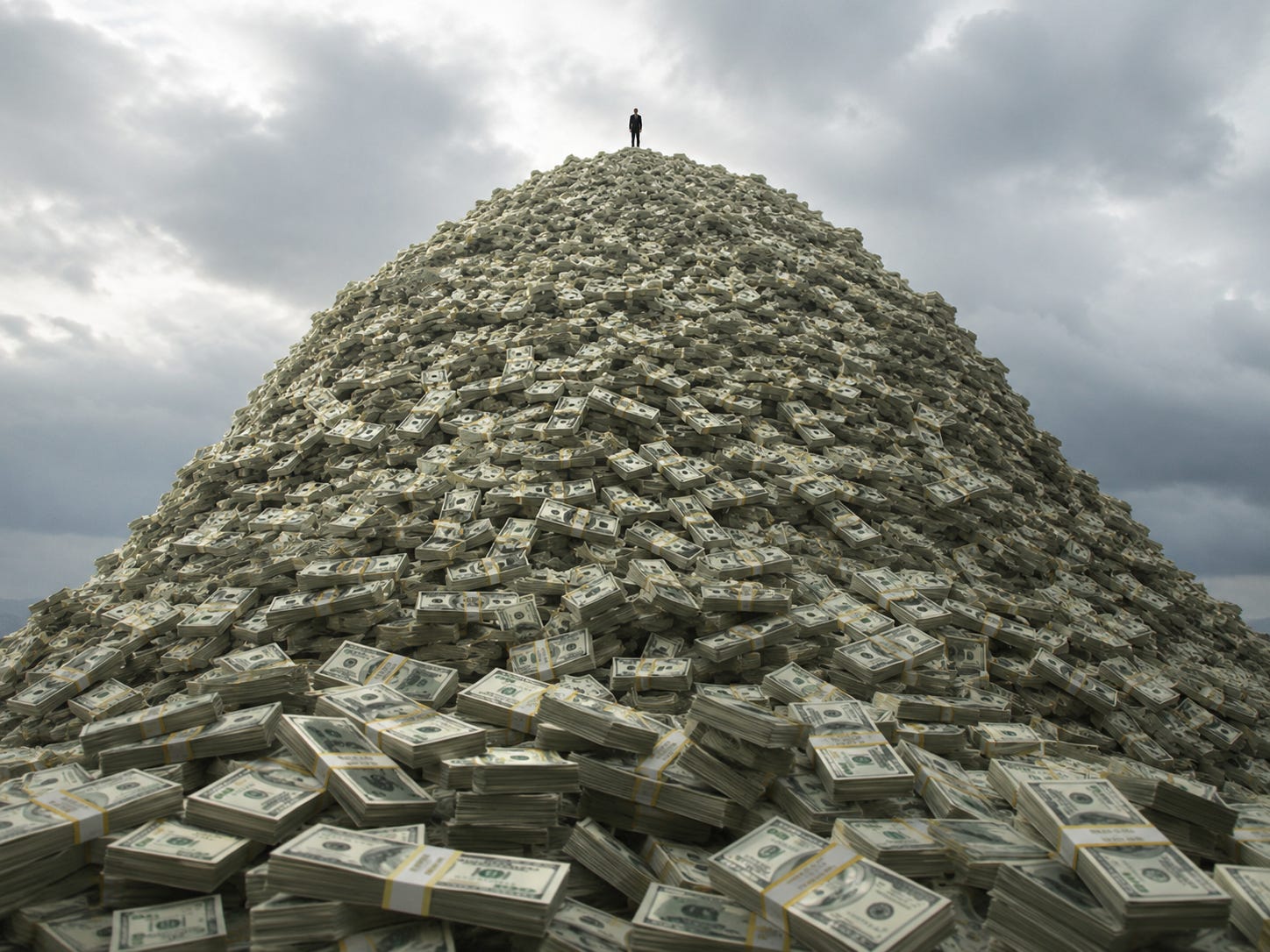
SpaceX goes public today, and humanity has created the world’s first trillionaire, Elon Musk. That reality should bother everyone.
It’s genuinely hard to convey how ludicrous this is. We’re not wired to understand numbers at this scale. CNN tried, listing things worth less than $1 trillion:
the GDP of all but twenty countries
the economy of Manhattan
all the cars and trucks bought in the U.S. in a year
every professional sports team on the planet
More than a year ago, when Musk hit $400 billion in wealth, I tried to picture it in everyday terms — i.e., how long would it take to get to $400 billion by accumulating a median family income every year, day, hour, minute, or second. Let’s update that for a trillion, using $100,000 as the unit of accumulation.
Here’s how long it would take to reach $1 trillion if you received $100,000…
Annually: 10 million years
Monthly: 833,000 years
Weekly: 192,000 years
Daily: 27,000 years
Hourly: 1,100 years
Per minute: 19 years
Per second: ~4 months
Just imagine $100,000 popping up in front of you every second…for 4 months.
I’m all for people who create useful things making money and becoming wealthy. But something’s broken when someone can amass this much wealth, especially by greatly inflating the value of their company. SpaceX is a real company with real revenue, but the market cap doesn’t hold up to scrutiny — Morningstar values SpaceX at half the IPO valuation. Everyone involved in this deal — the banks, the investors, the NASDAQ — is part of the problem.
Putting aside the absolute absurdity of someone being worth more than most countries, it’s also just plain gross because of this particular person and how he’s treated people, especially those less fortunate. When he gleefully cut all support for USAID as part of his DOGE program early last year, he caused an unbelievable amount of harm. By some estimates, his cuts are contributing to hundreds of thousands or even millions of deaths. As fellow giga-billionaire Bill Gates put it bluntly at the time of the cuts, “The picture of the world’s richest man killing the world’s poorest children is not a pretty one.”
Remember that the justification for these cuts was that we can’t afford it. And yet, this one person could fund the $30 billion-plus aid budget with a small percentage of his wealth.
Inequality, at this scale, is destabilizing. It fuels resentment, populism, and revolutions. It’s not remotely healthy for society.
I can’t say I have any big answers to this problem, but certainly wealth taxes come to mind. This isn’t an easy path; it’s been tried and hasn’t worked well. But the underlying principle is right — we just need the right mechanism. But no matter how thorny, we shouldn’t just shrug and accept a trillion-dollar fortune as a natural part of our system.
In parallel, the other big policy solution is some form of universal basic income to create a floor of sufficiency for all. Interestingly, one tech mogul has been talking about the possibility of something more ambitious: not just basic income support, but universal high income — i.e., a check from the government supporting a decent quality of life.
That mogul is Musk.
Of course, his version involves magical AI-generated abundance, which conveniently skips the far more likely path to redistribution…taxing the heck out of wealth like his. Something tells me he won’t be volunteering his trillions to help make that happen.
Meanwhile, "A good life for the 99% isn’t a pipe dream: it can be done. Here’s how.”
https://substack.com/@gfriend/note/c-275347942?utm_source=notes-share-action&r=n66c
Ba humbug 😎